Workflow Wednesday: What Other Departments Can Learn from Agentic Engineering
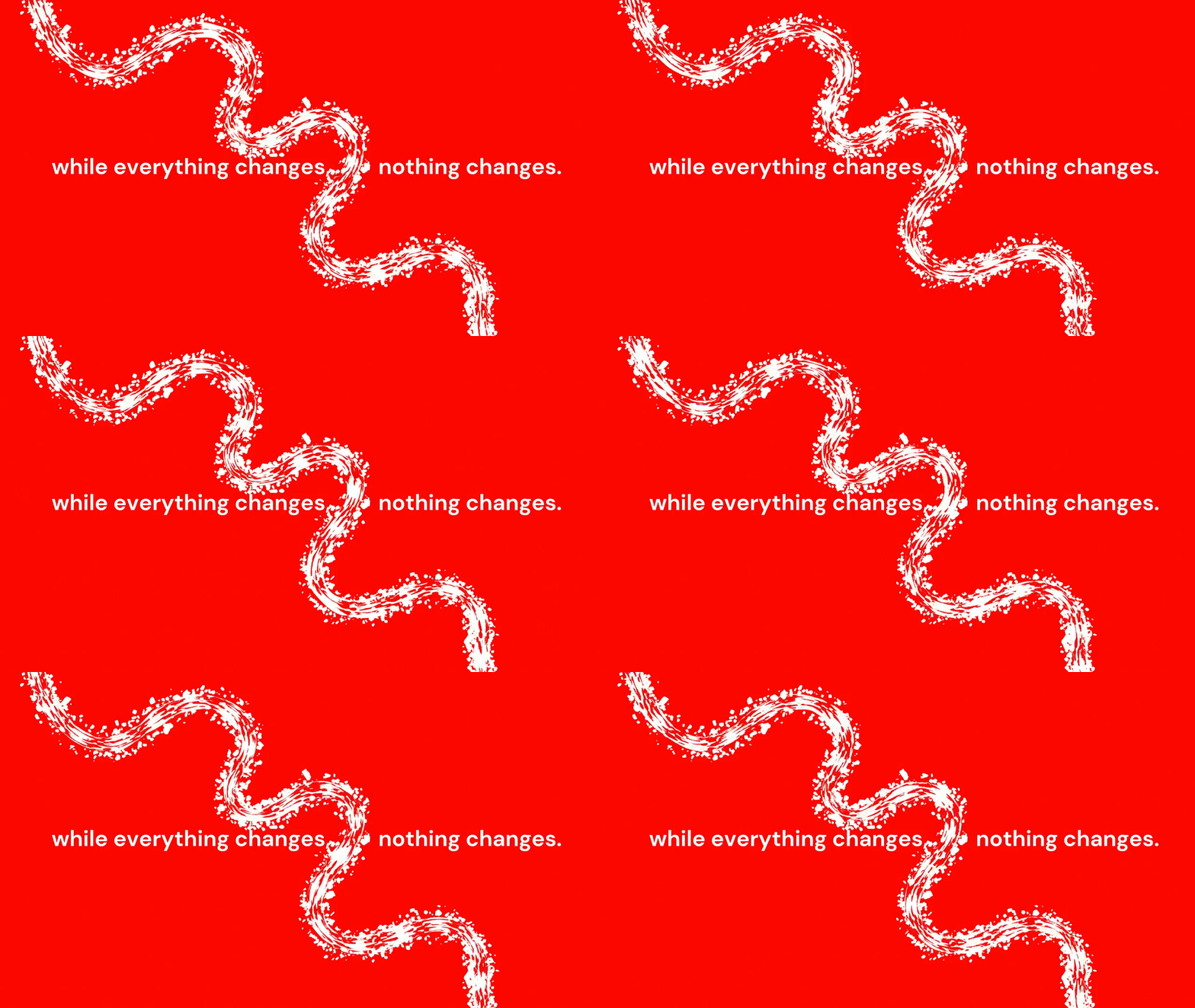
Art by @basilonmypizza: https://lnkd.in/eF8FkWzN - https://basilhefti.ch/
“By that time, the stream had grown up, … it did not run and jump as it used to do when it was younger, but moved more slowly… For it knew now where it was going.”
When observing the flurry of AI announcements, I am often reminded of this beautiful metaphor from A.A. Milne’s Winnie-the-Pooh stories.
When I started programming, I carried Kernighan and Ritchie’s The C Programming Language with me. I looked up function prototypes. With time, I learned many of them by heart. That made me faster.
Today, the situation is different. The coding agent does the lookup for me.
In fact, software engineering is undergoing a fundamental change. Developers increasingly orchestrate specialist capabilities that used to be separate roles: architecture, business analysis, testing, documentation, security review.
Steps that previously required handovers can now be explored directly in the development flow.
This is powerful. And uncomfortable.
Many IT organisations struggle to adapt. Some treat this as another developer tool. But agentic engineering changes the operating model. And creates two opportunities.
First, better business support: shorter loops from intent to productive systems.
Second, learning: software engineering is one of the first functions where we can observe what happens when roles are decomposed into capabilities, recombined, and orchestrated differently.
Other departments will face similar shifts soon. Legal, finance, HR, marketing, operations, customer service: specialist capabilities will move closer to the main process.
It would be a pity not to learn from IT’s transition.
When change accelerates and roles blur, orientation comes from fundamentals (we call them the invariants). They also hold in the AI world:
Keep artificial complexity low.
Separate concerns clearly.
Understand the essence of a requirement (instead of blindly following a rule).
Argue from first principles.
The tools change. The speed changes. The role boundaries change.
The principles do not.
In other words: while everything changes, nothing changes.
Where is your IT organisation today: treating it as a developer tool, already adapting ways of working, or shipping the first end-to-end agentic products in production?
—
• Art: https://lnkd.in/eF8FkWzN https://basilhefti.ch/
• The C programming language https://lnkd.in/eG3yWn_U
• Winnie-The-Pooh https://lnkd.in/eSW67Yht