Trend Tuesday: Digital Twins Eat Terabytes for Breakfast
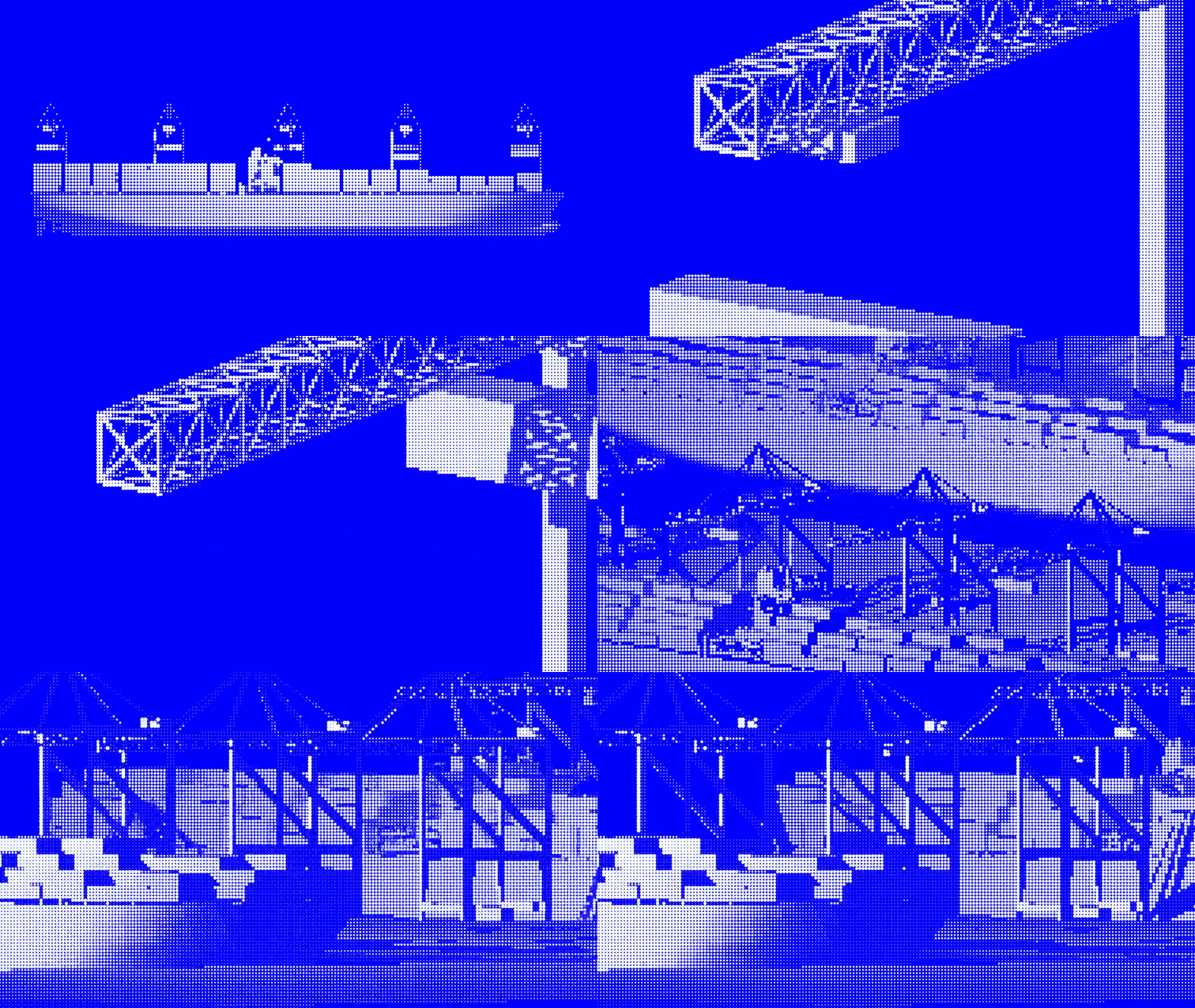
Art by @basilonmypizza: https://lnkd.in/eF8FkWzN - https://basilhefti.ch/
📊 Benchmarks like TPC-H usually stop at 100 TB. That sounds large, until you realize we’ve entered the petabyte era. Once you model entire fleets, cities, or biological systems, terabyte-scale platforms hit their limits fast.
The driver? Digital twins. 🧠
A single jet engine can generate terabytes of sensor data per hour. Simulate a whole fleet and you’re quickly in PB territory. Same for city-wide models: traffic, energy, climate. Or the gut microbiome: thousands of microbial species powering tens of thousands of shifting, interlinked metabolic pathways.
🏗️ A lakehouse is like a port. Parquet and ORC files are the containers, stacked in aisles. Each record is a package. Queries? Cranes, searching for the right package. Catalogs are the yard maps. Cranes must avoid collisions. Node failures? That’s a storm halting operations.
At petabyte scale, it’s still a port, just massive. Too many containers to scan naively. Too many cranes to coordinate manually. And if something breaks, there’s a lot of cargo to recover.
This isn’t theory. Adobe’s Experience Platform runs on Delta Lake at PB scale. HSBC “accidentally” built a PB-scale cybersecurity mesh. Uber’s Hudi? Petabytes. And Walrus combines blob storage and erasure coding for PB durability.
🚢 As digital twins get more faithful, PB-scale ports become the new normal.
How do you keep your port operational?
• HSBC, https://lnkd.in/e7CVugWP
• Uber / Hudi https://lnkd.in/ePyZJg7k
• Walrus, https://lnkd.in/e7kX5vEu
• Art by @basilonmypizza: https://lnkd.in/eF8FkWzN https://basilhefti.ch/